
Reviewed by Mayer Hyman, Payments Specialist | Reviewed for accuracy July 2026
Key Takeaways
- Encryption makes data unreadable with a key; tokenization replaces data with a meaningless placeholder that has no mathematical link back to the original.
- Tokenization can reduce PCI DSS scope because systems that only handle tokens aren’t exposed to the original sensitive data. Encryption alone doesn’t shrink compliance scope, since encrypted data is still considered sensitive.
- Customer PII remains the most frequently compromised data type in breaches, involved in 53% of cases, at an average cost of $160 per record (IBM Cost of a Data Breach Report, 2025).
- The strongest security architectures don’t pick one method. They layer encryption and tokenization so each covers the other’s weak point.
Two Different Ways to Protect the Same Data
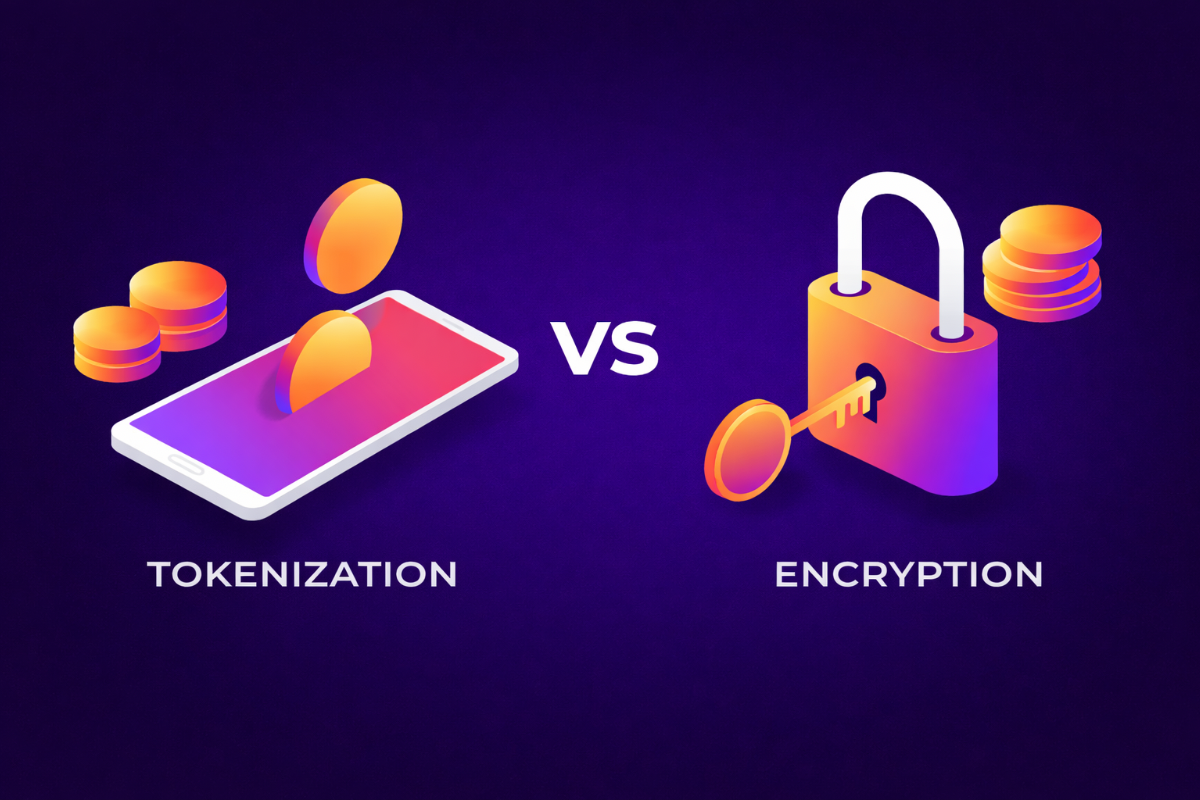
Encryption makes data unreadable with a key; tokenization replaces data with a meaningless placeholder that has no mathematical link back to the original. Both aim to secure the same sensitive data, but the mechanics are different enough that understanding the distinction shapes risk position, compliance strategy, and competitive edge.
Encryption: Reversible Protection Backed by a Key
Encryption transforms readable data into unreadable ciphertext using mathematical algorithms and a secret key. Only someone with that key can decrypt it back into usable information. It’s indispensable for protecting data, from financial transactions to personal information, but if the encryption key is compromised, so is the data it protects.
Tokenization: Removing the Sensitive Data Entirely
Tokenization, on the other hand, replaces sensitive data with a meaningless token that has no mathematical relationship to the original information. Tokens are stored in a secure vault, and outside systems work with the token instead of the raw data. Even if someone steals a token, it’s useless without access to the secure vault, drastically reducing exposure in a breach.
Why the Distinction Actually Matters
Risk Reduction
Tokens eliminate sensitive data from your systems entirely, dramatically shrinking the opportunity for security breaches. Encryption protects data, but it doesn’t remove it, meaning systems handling encrypted data remain targets. That distinction carries real weight: customer PII is compromised in 53% of data breaches, at an average cost of $160 per record (IBM Cost of a Data Breach Report, 2025). Data that was never stored in a usable form in the first place can’t contribute to that number.
Compliance Impact
Proper tokenization can reduce the scope of standards like PCI DSS, because systems handling tokens may fall outside of stringent compliance requirements. Encryption alone doesn’t typically reduce compliance scope, since encrypted data is still considered sensitive and remains in-scope for audits.
Operational Efficiency
Encrypted data still needs key management, a logistical and security burden, whereas tokenization doesn’t require encryption keys and therefore avoids key-related vulnerabilities.
Secure Analytics
Tokenization can preserve the format of the original data, allowing analytics and business processes to run on tokens without exposing sensitive content. Encryption often renders data unusable without decryption first.
The Real Answer: Layer Them, Don’t Choose Between Them
There’s a powerful truth to embrace here: this isn’t about choosing one over the other, it’s about layering them. In many mature security architectures, encryption protects data in transit and at rest, while tokenization removes sensitive data from business-critical systems altogether. This layered approach materially improves resilience against breaches and helps future-proof an organization against evolving threats.
Large-scale data breaches are no longer a risk limited to a handful of retailers. They occur across industries and geographies with enough regularity that regulatory scrutiny keeps intensifying in response. Leaders who understand how and when to apply encryption and tokenization gain a strategic advantage, not just in security, but in trust, compliance, and long-term growth.
Protecting your data isn’t just good IT practice, it’s good business. Cartis Payments works with merchants and ISVs to apply the right mix of tokenization and encryption inside their payment flows, rather than defaulting to whichever one a vendor happens to sell.
FAQ
Is tokenization more secure than encryption?
Neither is universally “more secure” on its own; they solve different problems. Encryption protects data that still needs to be used or restored to its original form. Tokenization removes sensitive data from a system entirely by replacing it with a non-sensitive placeholder. Most mature security architectures use both.
Does tokenization eliminate PCI DSS compliance requirements?
No, but it can significantly reduce scope. Systems that only ever handle tokens, and never touch the original cardholder data, may fall outside the strictest PCI DSS requirements, which lowers audit burden and cost.
Can tokenized data still be used for analytics or business reporting?
Yes, if the tokenization method preserves the format of the original data. Analytics and reporting systems can run on tokens directly without ever needing to decrypt or expose the underlying sensitive values.
That kind of format-preserving choice ultimately gets evaluated against a compliance baseline — see PCI Compliance Isn’t a Checkbox Item for what that baseline actually requires in 2026.