
Reviewed by Mayer Hyman, Payments Specialist | Reviewed for accuracy July 2026
Key Takeaways
- WordPress still powers roughly 41-42% of all websites, and WooCommerce remains the leading ecommerce platform among sites where the underlying system is known (W3Techs).
- Growth has slowed from its pandemic-era surge, but slower growth is not the same as decline.
- WooCommerce’s open-source model keeps it flexible: thousands of themes and extensions, an active developer community, and continuous plugin innovation in AI, AR, and voice search.
- Security is a real, ongoing cost of that popularity: WordPress’s market share makes it the most-targeted CMS on the web, which means merchants need active plugin management, not a “set it and forget it” mindset.
Has WooCommerce Peaked?
No, WooCommerce hasn’t peaked: growth has slowed from its pandemic-era surge, but slower growth isn’t the same as decline, and WooCommerce still holds close to half the market among sites with an identifiable ecommerce platform. eCommerce is a competitive arena, and the number of eCommerce websites keeps climbing, so merchant demand for new capabilities, from augmented reality to crypto transactions, never really stops.
WordPress has experienced sustained success as a content management system, and its ecommerce add-on, WooCommerce, has powered its rise as one of the leading ecommerce hosting platforms. But how sustainable is WooCommerce’s market position as new entrants and platforms continue to emerge? Has WooCommerce reached a mature, steady stage of its lifecycle, or is it on a downward trajectory?
This article looks at where WordPress and WooCommerce stand today and what that means for merchants who build on the platform.
The Rise of WordPress and WooCommerce
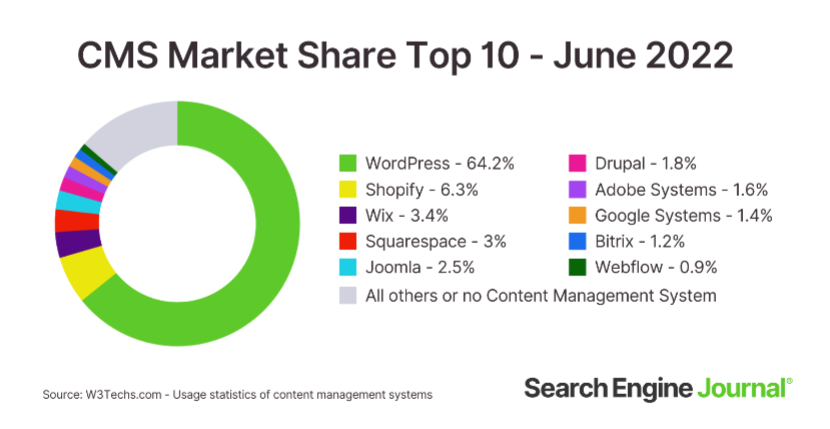
WordPress remains the dominant content management system, used by roughly 41-42% of all websites, well ahead of Shopify’s single-digit share. Among the smaller set of sites where the ecommerce platform is identifiable, WooCommerce accounts for close to half (W3Techs, 2026). That is a big, durable footprint for a plugin that started as a side project.
WordPress was first launched in 2003, and WooCommerce, an ecommerce solution for WordPress, emerged in 2011 under the name WooThemes, created by Adii Pienaar, Magnus Jepson, and Mark Forrester.
WooThemes was acquired by Automattic and renamed WooCommerce, a deal that turned out to be one of the more consequential acquisitions in ecommerce infrastructure history.
WooCommerce is an open-source plugin for WordPress, meaning anyone can access and modify the code. That openness has always been part of its appeal, customizable and straightforward to use, but a few other features cemented its position as a market leader.
- Thousands of free and paid WooCommerce themes and extensions.
- A setup wizard that gets a store up and running within hours.
- A range of popular payment facilities serving merchants and their customers.
- Easy store design and branding with pre-built themes.
- A strong developer community offering support, guides, and tutorials.
WordPress also released its Dokan plugin as a single-seller online selling platform that doubles as a base for multi-vendor marketplaces. With Dokan, merchants can build marketplaces similar to eBay and Amazon and earn passive income from commissions.
All this success, however, doesn’t mean WordPress and WooCommerce face no challenges.
For more on the pros and cons of WooCommerce, read “Looking for An eCommerce Platform? 15 Things Merchants Should Know Before They Commit to WooCommerce“
Criticisms of WooCommerce
Concerns about WooCommerce tend to center on slightly slower growth after the pandemic-era surge, rising competition, and ongoing security and maintenance demands.
According to Barn2, a UK-based WordPress software company, Google search interest in “WordPress” has been gradually declining for years, which some read as a sign that WordPress has peaked. Meanwhile, competitors like Shopify and Magento have each built out solid market positions.
Search interest cooling off is not the same as market share collapsing, though. WordPress’s actual share of the web has held remarkably steady over the past several years even as the total number of websites has grown.
The pandemic era saw a massive surge in people launching WordPress and WooCommerce stores as many turned to online business during lockdowns. WooCommerce’s competitors benefited from that same wave, so a cooling-off period afterward, as ecommerce growth normalized, was largely unavoidable and not unique to WooCommerce.
Security and maintenance are the more legitimate ongoing concerns. WordPress’s popularity makes it a constant target for automated attacks, simply by virtue of running such a large share of the web’s sites. That is not a reason to avoid the platform, but it is a reason active plugin and security management can’t be an afterthought.
On ease of use, some website builders are considered quicker to set up out of the box. WordPress historically lacked a built-in page builder, requiring a developer or a third-party plugin, and even its eventual native editor drew mixed reviews at launch.
Ultimately, the platforms that hold their ground in ecommerce hosting are the ones that keep innovating and answering merchant demand for new capabilities. Let’s look at how WordPress and WooCommerce stack up on that score.
WooCommerce and Innovation
WordPress continues to invest in its core editing experience while WooCommerce pushes into artificial intelligence, augmented reality, progressive web apps, voice search, product personalization, security enhancements, and blockchain payment support.
Gutenberg Editor
The Gutenberg editor has been under active development for years as a long-term, staged project. Its goal is to simplify website creation for non-coders, widening the pool of people who can build and maintain a store without hiring a developer.
WordPress was originally built in PHP, but development has shifted toward JavaScript, which aligns with Gutenberg’s architecture. The project also aims to make merchant sites more accessible in other languages, so store owners and their customers can work in their native language.
Augmented Reality
Augmented reality is already a widely used tool on ecommerce sites. Virtual dressing rooms and the ability to place products in a customer’s actual living room are popular, proven features.
The Augmented Reality for WooCommerce plugin puts 3D models into an interactive viewer directly inside a WooCommerce shopping cart, creating an AR shopping experience without extra development.
Big retailers like Home Depot and IKEA have already integrated AR into their apps and websites, letting customers preview how colors and furniture would look in their own homes before buying.
Progressive Web Applications (PWA)
WordPress continues to focus on mobile users. Progressive Web App plugins let a WooCommerce site perform like a mobile app without building a separate native app, and dedicated mobile apps let merchants manage their stores from a phone.
Voice Search
With voice assistants now a standard part of many households, WooCommerce offers voice search plugins supporting well over 100 languages.
Personalized Products
WooCommerce merchants can offer the same personalized-product experience as major brands by adding a plugin like Fancy Product Designer. Just as shoppers can personalize sneakers on major brand sites, WooCommerce merchants can offer the same kind of customization through plugins like Fancy Product Designer, which lets customers upload their own media, pick colors, add text, and adjust image placement and size.
Security Advancements
WordPress core software is audited regularly by a large developer community, and WooCommerce security plugins are continuously updated to guard against DDoS attacks, phishing, and other common threats. Sucuri, Jetpack, and Wordfence remain among the most widely used.
Blockchain Technology
As cryptocurrency payments gain traction with certain customer segments, WordPress crypto plugins like MyCryptoCheckout, NOWPayments, and Blockonomics help merchants accept crypto payments without building custom infrastructure.
Strategic Partnerships
WooCommerce keeps striking new partnerships to extend its reach. A Pinterest extension lets merchants convert product catalogs into shoppable pins, and a TikTok plugin lets merchants connect their catalog, activate pixel tracking, and launch ads directly from the WooCommerce dashboard.
The Future of WooCommerce
WooCommerce remains one of the most widely used ecommerce hosting platforms available. After a slower growth period following its pandemic-era peak, the platform has held its ground against competitors and new market entrants, continuing to ship new plugins and update its existing products.
For now, merchants who build their stores on WooCommerce can be reasonably confident there’s plenty of life left in the platform, and thanks to its open-source model and large developer community, there’s likely already a plugin, or soon will be, for whatever a merchant needs next.
Whichever platform a merchant builds on, the payments layer behind it matters just as much as the plugin ecosystem. Cartis Payments is a payment processing provider, not an ecommerce platform, offering global payment tools to help merchants capture more sales and reduce chargebacks and fraud.
FAQ
Is WooCommerce declining in popularity?
No. Growth has slowed from its pandemic-era surge, but WooCommerce still holds close to half of the market among sites with an identifiable ecommerce platform, and WordPress’s overall CMS share has stayed roughly steady for years (W3Techs, 2026).
Is WooCommerce secure enough for a growing ecommerce business?
WordPress’s core software is regularly audited, but its popularity makes it a frequent target for automated attacks. Active security plugin management (Wordfence, Sucuri, Jetpack) is essential rather than optional at any meaningful scale.
What should merchants watch for if WooCommerce’s growth keeps slowing?
Plugin ecosystem health and update cadence matter more than raw market share. As long as WooCommerce keeps shipping security updates and new integrations (AI, AR, social commerce), a slower growth rate isn’t itself a red flag.